
Coffee Companies Join Forces to Finance Farmer Health at Scale in Uganda
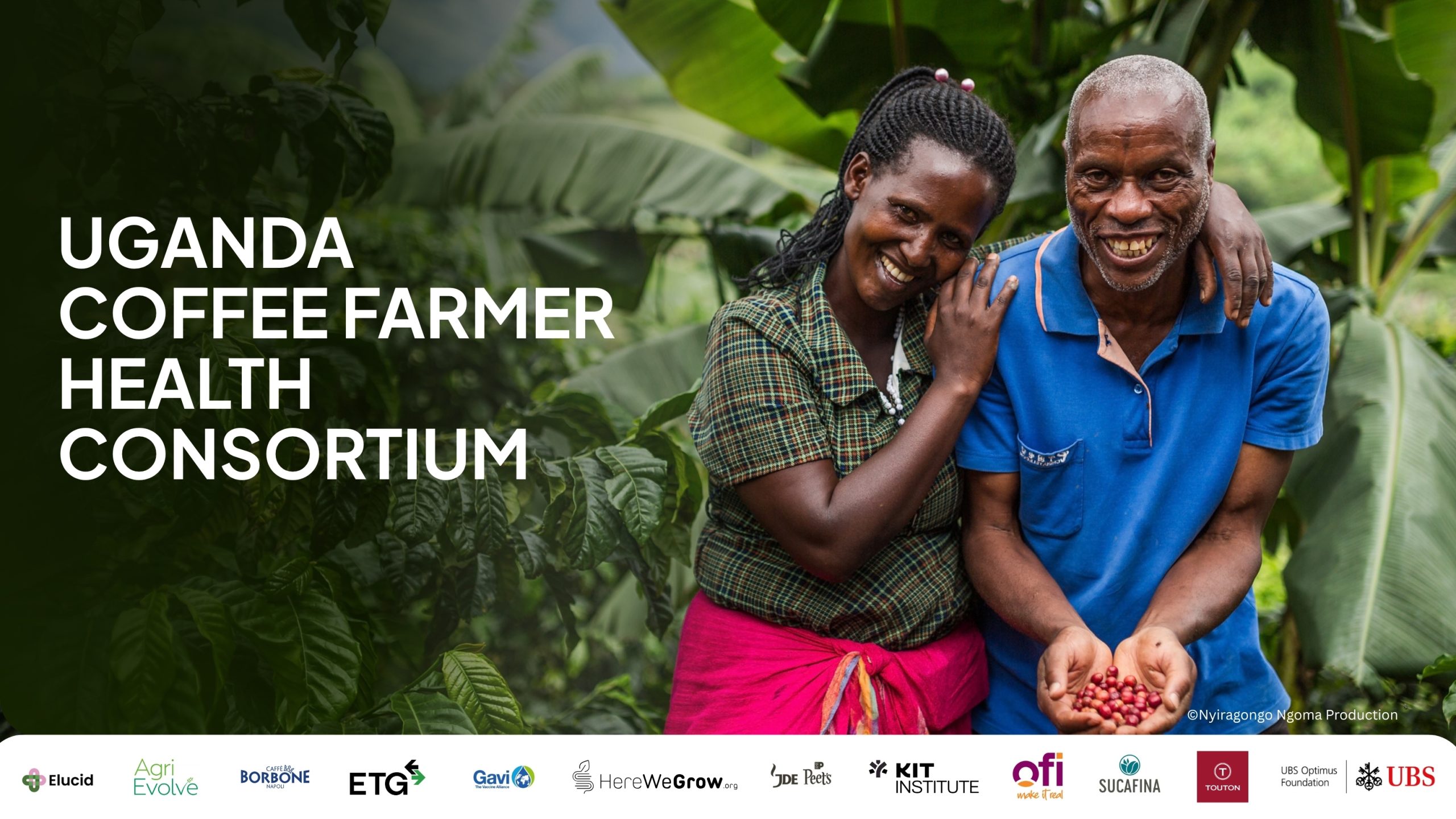
The new pre-competitive consortium brings together coffee companies, public and philanthropic partners to improve healthcare access for farming communities and strengthen the resilience of Uganda’s coffee sector.
Kampala, 23 September 2026 — A health financing approach first tested by pioneering coffee companies in Uganda has grown into a pre-competitive health consortium, called the Uganda Coffee Farmer Health Consortium, spanning the Greater Masaka, Ankole and Rwenzori regions. It brings together public, private and philanthropic partners to finance farmer health at scale, reaching around 15,000 people directly in the supply chain and a further 50,000 people across surrounding coffee-growing communities.
The work began in 2025 with two parallel projects testing whether pooling resources to deliver healthcare in coffee-growing communities could work: one with Sucafina and JDE Peet’s, and another with Export Trading Group (ETG), Ndugu and Pure Africa, each partnering with social enterprise Elucid and supported by funding from the Netherlands Enterprise Agency (RVO). With proof of principle established across both, Olam Food Ingredients (ofi) joined to help open the approach to the wider sector, marking the first time coffee companies have come together pre-competitively to finance farmer health in Uganda.
Today, the consortium brings together coffee companies Agri Evolve, Caffè Borbone, ETG, JDE Peet’s, ofi, Sucafina and Touton, alongside Gavi, the Vaccine Alliance, HereWeGrow, KIT Institute and UBS Optimus Foundation, with Elucid as implementation partner. They are united around a simple principle: farmer health should not be the grounds upon which companies compete.
Paulo van der Ven, Head of Coffee Sustainability, Africa, ofi
“Healthy farming communities underpin resilient, reliable supply chains. Drawing on years of direct engagement with more than 14,000 coffee farmers in Uganda and implementing health and well-being initiatives through ofi’s Healthy Living Programme, we saw an opportunity with Elucid to unite the sector around this shared challenge. We’re proud to have helped turn that ambition into a consortium with the potential to drive action at scale.”
Louisa Marie Truss, Head of Global Partnerships, Elucid
“Healthy farming communities are a shared interest across the coffee sector. By pooling resources, companies can share healthcare costs, unlock catalytic capital and build evidence on the returns. Ultimately, we want to move farmer health from individual projects into responsible coffee procurement, with a model that can sustain and scale it.”
Why farmer health?
For coffee-farming households, a single illness can mean lost workdays, delayed harvests and financial pressure, with consequences extending from household income to the wider supply chain. A baseline study conducted under the AFYA project found that 47% of households delayed medical care, the majority due to cost, while one in four pre-sold coffee at reduced prices to cover health expenses.
One shared platform for farmer health
Through the consortium, companies finance cashless access to vetted clinics and pharmacies for essential, maternal, and emergency care, complemented by mobile clinics offering services such as eye screenings and other preventive care. Elucid manages implementation, from household enrolment and service delivery to claims and results tracking.
The model is pre-competitive: companies pool resources around farmer health while continuing to compete commercially. Each tracks progress in its own supply chain, while the consortium reports results collectively. New companies can join the shared infrastructure without building a separate programme from scratch.
More than €2.5 million for health in Uganda’s coffee communities
The initiative represents an investment of more than €2.5 million over three years, combining coffee-sector, public, and philanthropic funding. HereWeGrow will support learning and broader community reach, while Gavi’s Matching Fund, supported by the Dutch government and UBS Optimus Foundation, will fund vaccination and health-system strengthening.
Building the evidence together
The consortium will build evidence on the relationship between healthcare access and farmer income, farmer loyalty, productivity, and resilience. A Community of Practice convened by KIT Institute will bring together participating companies, technical partners, and Elucid to review findings, share lessons, and refine the model – helping turn evidence from Uganda into practical insights for scaling farmer health across the coffee sector.
Timeline
Phase A began in September 2026, bringing consortium members together to establish a shared impact framework and prepare for implementation. The consortium remains open to additional coffee companies during this phase, ahead of the full three-year programme launch in January 2027.
Consortium partners
Confirmed coffee traders:
Agri Evolve; Export Trading Group; ofi; Sucafina; Touton
Confirmed coffee roasters:
Caffè Borbone; JDE Peet’s
Confirmed public and philanthropic partners:
Gavi, the Vaccine Alliance; HereWeGrow; UBS Optimus Foundation
Implementation partner:
Elucid
Community of Practice Convener:
KIT Institute
Media contact
Elucid: Louisa Marie Truss, Head of Partnerships | louisa.truss@elucid.de
About participating consortium partners
About Elucid
Elucid is a social enterprise embedding healthcare into global agricultural supply chains. Working with companies, cooperatives, governments and healthcare providers, Elucid designs and implements programmes that improve access to affordable healthcare for farmers, workers, their families, and surrounding communities while strengthening the resilience of agricultural supply chains.
Its model combines health financing, digital infrastructure, local implementation, and real-time data systems to enrol farming households, coordinate healthcare delivery, and measure health, social, and business outcomes. By reducing preventable illness and protecting families from health-related financial shocks, Elucid helps companies strengthen responsible sourcing and build more resilient farming communities.
Elucid is active across six countries and five agricultural supply chains.
About Agri Evolve
At Agri Evolve, we source, process, and export arabica coffee from smallholder farmers in the Rwenzori Mountains of western Uganda. We were established in 2015 and, with a team of 150 full-time staff, we work on the ground with over 20,000 smallholder farmers, supporting them to improve yields, quality, and market access so that farming families and their communities can grow their productivity, income, and living standards.
Our work goes well beyond buying and selling coffee. We invest in community development through education, in environmental work such as reforestation and climate adaptation, and in full supply-chain transparency, with SAP running across our operations. We became a Certified B Corporation in September 2023, joined the Global Coffee Platform in November 2023, and take part in GCP collective-action work including the ACE programme; our coffee is also produced under Rainforest Alliance standards.
About Export Trading Group (ETG)
Export Trading Group (ETG) is a global agri-business operating across six continents, connecting farmers to international markets through sourcing, processing, logistics and trade. Through its coffee business, ETG has established a significant footprint in Uganda, where it sources, processes and exports coffee while working directly with over 10.000 farmers with cooperatives and supply-chain partners. ETG’s sustainability programmes focus on environmental resilience, traceability, regenerative agriculture, farmer livelihoods, health, gender inclusion and human rights, helping build more sustainable and resilient coffee supply chains for global customers.
About Gavi, the Vaccine Alliance
Gavi, the Vaccine Alliance is a public-private partnership that helps vaccinate more than half the world’s children against some of the world’s deadliest diseases. The Vaccine Alliance brings together developing country and donor governments, the World Health Organization, UNICEF, the World Bank, the vaccine industry, technical agencies, civil society, the Gates Foundation and other private sector partners. View the full list of donor governments and other leading organisations that fund Gavi’s work here.
Since its inception in 2000, Gavi has helped to immunise a whole generation – over 1.2 billion children – and prevented more than 20.6 million future deaths, helping to halve child mortality in 78 lower‑income countries. Gavi also plays a key role in improving global health security by supporting health systems as well as funding global stockpiles for Ebola, cholera, meningococcal and yellow fever vaccines. After two decades of progress, Gavi is now focused on protecting the next generation, above all the zero-dose children who have not received even a single vaccine shot. The Vaccine Alliance employs innovative finance and the latest technology – from drones to biometrics – to save lives, prevent outbreaks before they can spread and help countries on the road to self-sufficiency.
About KIT
KIT Institute is an independent knowledge institute focusing on global health, gender equality and sustainable economic development. Founded in Amsterdam in 1910, KIT works to improve health, promote fair socio-economic conditions and advance sustainable development in line with the Sustainable Development Goals. Its team of experts works across health systems strengthening, epidemiology, sexual and reproductive health and rights, food and agribusiness, impact economics and gender. It shares its knowledge through research, evaluation, advisory services, teaching and training. KIT works with partner-country governments, UN agencies, NGOs, bilateral agencies and the private sector, mainly in low- and middle-income countries. In agricultural supply chains, its work ranges from inclusive value chain development to a fair living income for smallholder farmers. Its health teams evaluate global health programmes and support equitable access to quality care at every level of the health system, down to households and communities. KIT grounds all of its work in rights, participation and gender equality, and adapts its approach to local contexts and to the priorities of the partners it works with.
About ofi
ofi (olam food ingredients) is an operating group born out of Olam. ofi offers natural, value-added food products and ingredients, including those sourced through sustainability programmes and initiatives, so that consumers can enjoy the healthy and indulgent products they love. It consists of industry-leading businesses of cocoa, coffee, dairy, nuts, and spices. ofi has built a unique global value chain presence including its own farming operations, farm-gate origination, and manufacturing facilities. ofi partners with customers, leveraging its complementary and differentiated portfolio of ‘on-trend’ food products, to co-create solutions that anticipate and meet changing consumer preferences as demand increases for healthier food that’s traceable and sustainable.
In Uganda, ofi is a major coffee originator and exporter, with 29 years of operations in the country. Through a sourcing network spanning Western, Central and Eastern regions, ofi works directly with approximately 14,000 coffee farmers to supply major roasters and manufacturers globally.
About Sucafina
Sucafina is the leading sustainable Farm to Roaster coffee company, with a family tradition in commodities that stretches back to 1905. Today, with more than 1,500 employees in 42 countries, we help stakeholders worldwide to find the perfect coffee solutions. We embed technology, innovation, and sustainability throughout the supply chain, creating shared value for all by Investing in Farmers, Caring for People, and Protecting Our Planet. For more information, visit www.sucafina.com.
About Touton
Since 1848, the Touton group has been sourcing, trading, processing and supplying exceptional tropical agricultural products to food manufacturers all over the world, using an approach that is true to its values: ever more sustainable and profoundly human. Acting as a true link between growers and processors, from the field to the factory, we create responsible supply chains in our areas of expertise: cocoa and its derivatives, green and specialty coffee, vanilla and exotic ingredients. As field players, we are involved at every level of the value chain to deliver unprecedented quality of service in sourcing, trading, logistics, and market intelligence. Our collective approach is driven by a shared conviction: the performance of our long-term business relations depends on our ability to establish and maintain a bond of shared trust with all our partners.
About UBS Optimus Foundation
UBS Optimus Foundation is an independent foundation that offers UBS clients a platform to use their wealth to drive positive social and environmental change. The Foundation selects programs that improve children’s health, education, and protection, ones that have the potential to be transformative, scalable, and sustainable as well as programs tackling environmental and climate issues.
Related content
-
 Elucid, The Hershey Company, and ECOM announce the launch of a health program in Ghana aimed at improving access to healthcare for cocoa farming
-
 Recently, the social enterprise Elucid has become a member of our community. Elucid is committed to providing access to quality healthcare for smallholder producers within global supply chains. In the interview below, Louisa Marie